Posted by
on
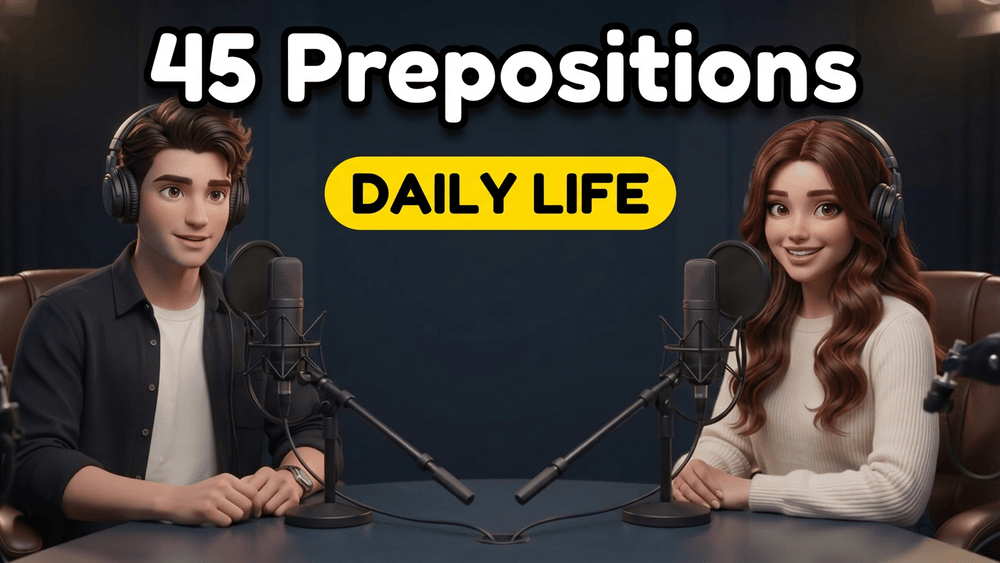
Speaker 1: Let me ask you something, Anji. If I say, “I’m on the bus,” but then I say, “I’m in the car,” why do I use “on” for one and “in” for the other? And why do we say, “I’m at home,” but “I’m in my bedroom”? If you’ve ever wondered about these little words, you’re not alone!
Speaker 2: Oh, Sam! English prepositions can be so confusing. Sometimes, one small word changes the entire meaning of a sentence. You might know all the vocabulary, but if you choose the wrong preposition, your sentence can sound unnatural.
Speaker 1: Exactly! And here’s the interesting part: prepositions are everywhere. We use them when we talk about time, places, travel, work, relationships, daily routines, and even our feelings.
Speaker 2: That’s why today we’re going to make them easier to understand. We’re going to explore 45 useful English prepositions and expressions through real-life situations, so you can understand them and start using them in everyday conversations.
Speaker 1: And don’t worry. We’re not going to give you a boring list of words to memorize. Sam and Anji are going to have a natural conversation, share examples, ask questions, and explain how these little words work in real life.
Speaker 2: So, listen carefully, think about the examples, and notice how the prepositions fit into each sentence. You don’t have to learn all 45 at once. Just start recognizing them and practice using a few at a time.
Speaker 1: Hello, everyone! Welcome back to the Sam and Anji English Podcast. I’m Sam, and today we’re talking about one of the most useful topics for anyone learning English.
Speaker 2: And I’m Anji! We’re happy you’re here with us. Whether you’re a beginner or you’ve been learning English for a while, this episode will help you understand many expressions you hear every day.
Speaker 1: Anji, before we begin, tell me something. When you were learning English, which prepositions confused you the most?
Speaker 2: Honestly, Sam, I used to confuse “in,” “on,” and “at” all the time. I’d say things like “at Monday” instead of “on Monday,” or “in night” instead of “at night.”
Speaker 1: Those are common mistakes! The good news is that you can learn the patterns through examples. Let’s start with the prepositions we use to talk about time.
Speaker 2: Great! Because we’re always talking about time. We have appointments, meetings, deadlines, holidays, and plans.
Speaker 1: Let’s begin with “at.” We often use “at” for a specific time. For example, “I wake up at six o’clock,” “The meeting starts at nine,” or “I’ll call you at five.”
Speaker 2: So, if someone asks me, “What time does your class begin?” I can say, “It begins at eight thirty.”
Speaker 1: Exactly! Now, let’s talk about “on.” We often use “on” with days and dates. For example, “I’ll see you on Monday,” “My birthday is on June tenth,” or “We’re meeting on Friday evening.”
Speaker 2: So, I should say, “I have an appointment on Tuesday,” not “at Tuesday.”
Speaker 1: That’s right. And the third important preposition is “in.” We often use “in” with months, years, seasons, and longer periods of time.
Speaker 2: For example, “I was born in 2000,” “My birthday is in October,” and “We usually travel in summer.”
Speaker 1: Exactly. Let’s put those three together. “At” six o’clock. “On” Monday. “In” October.
Speaker 2: And “at” night, too! That’s one I need to remember because I used to say “in night.”
Speaker 1: Yes, we commonly say “at night,” but “in the morning,” “in the afternoon,” and “in the evening.”
Speaker 2: English loves its exceptions, doesn’t it, Sam?
Speaker 1: It certainly does! But don’t let that discourage you. The more you hear these expressions in context, the more familiar they become.
Speaker 2: Let me try a few sentences. “I exercise in the morning. I have lunch at noon. I study in the evening, and I usually go to bed at night.”
Speaker 1: Perfect! And here’s another useful time expression: “by.” We use “by” to talk about a deadline, meaning no later than a particular time.
Speaker 2: For example, “Please finish this report by Friday.” That means Friday is the deadline.
Speaker 1: Exactly. If your friend says, “Can you send me the photos by tonight?” they’re asking you to send them no later than tonight.
Speaker 2: And how is “by” different from “until”?
Speaker 1: Good question! “Until” describes how long something continues. For example, “I’ll work until five o’clock.” That means I’ll continue working and stop at five.
Speaker 2: So, “Finish the task by five” means the task must be completed no later than five. But “I’ll work until five” describes the time when my work ends.
Speaker 1: Exactly! That difference is very useful in everyday English.
Speaker 2: What about “before” and “after”? Those seem easier.
Speaker 1: They are quite straightforward. “Before” means earlier than a time or event. “After” means later than a time or event. For example, “Wash your hands before dinner,” and “Let’s go for a walk after lunch.”
Speaker 2: I could also say, “I always check my emails before work,” and “I usually relax after work.”
Speaker 1: Absolutely. And you can use these words when talking about a sequence of events. “Before I leave home, I check that I’ve locked the door.” “After I get home, I change my clothes.”
Speaker 2: These are great expressions for describing a daily routine. So far, we’ve covered “at,” “on,” “in,” “by,” “until,” “before,” and “after.”
Speaker 1: That’s seven useful prepositions already. Now, let’s move from time to place. This is where many learners start feeling confused again.
Speaker 2: Oh, I know! Because we can say “in the room,” “on the table,” and “at the station.” All three describe places, but they don’t mean the same thing.
Speaker 1: Exactly. Let’s start with “in.” We often use “in” when something is inside a space or an enclosed area. For example, “The keys are in my bag,” “She’s in the kitchen,” or “There are many people in the room.”
Speaker 2: We can also use “in” with cities and countries. For example, “I live in Bangladesh,” or “My friend lives in Dhaka.”
Speaker 1: Correct. Now, “on” is often used when something is on a surface. “The phone is on the table.” “Your jacket is on the chair.” “There’s a picture on the wall.”
Speaker 2: And we also use “on” for certain forms of transport, like “on the bus,” “on the train,” and “on a plane.”
Speaker 1: That’s right. But for a typical passenger car, we usually say “in the car.” So you might say, “I’m in the car, but my brother is on the bus.”
Speaker 2: That’s one of those patterns that becomes easier when you remember the whole expression rather than trying to work out every sentence from scratch.
Speaker 1: Exactly! Now, let’s talk about “at.” We often use “at” when we think of a place as a point or location. For example, “I’ll meet you at the station,” “She’s at work,” or “We’re waiting at the entrance.”
Speaker 2: So, if I’m inside a building and want to emphasize that I’m physically inside a room, I might say, “I’m in the meeting room.” But if I’m talking about my location generally, I might say, “I’m at the office.”
Speaker 1: That’s a good way to understand the difference. The exact choice can depend on what you’re emphasizing.
Speaker 2: Let me try another example. “I’m at the airport, and I’m waiting in the departure lounge.”
Speaker 1: Perfect! You’re using “at” for the general location and “in” for the space you’re inside.
Speaker 2: What about “under” and “below”? Are they the same?
Speaker 1: They’re similar, but not always interchangeable. “Under” often describes something directly beneath another object or covered by it. For example, “The cat is under the table,” or “My shoes are under the bed.”
Speaker 2: And “below” often describes a lower position or level. For example, “The temperature is below zero,” or “Please read the instructions below.”
Speaker 1: Exactly. We can also use “above” to describe something at a higher level. For example, “The clock is above the door,” or “The temperature is above thirty degrees.”
Speaker 2: So, “under” and “above” can describe physical positions, while “below” and “above” can also describe levels, numbers, and information.
Speaker 1: Right! And another useful pair is “in front of” and “behind.”
Speaker 2: Those are easy to picture. “The bus stop is in front of the supermarket,” and “The parking lot is behind the building.”
Speaker 1: Exactly. Imagine you’re looking for your friend in a busy café. You call and ask, “Where are you?” Your friend replies, “I’m sitting in front of the window, near the door.”
Speaker 2: Or they might say, “I’m behind the counter,” if they work at the café.
Speaker 1: Correct. We can also use “next to” and “beside” when two things are close together or directly alongside each other.
Speaker 2: For example, “The pharmacy is next to the bank,” or “Please sit beside me.”
Speaker 1: Exactly. “Next to” is very common in everyday conversation. “Beside” has a similar meaning, although the tone can vary by context.
Speaker 2: And what about “between” and “among”? I sometimes confuse those two.
Speaker 1: That’s a great question. We commonly use “between” when talking about two people or things, or about distinct items considered separately. For example, “The café is between the bank and the bookstore.”
Speaker 2: And “among” is often used when something is part of or surrounded by a group. For example, “She was sitting among her friends.”
Speaker 1: Exactly. You might say, “I had to choose between two shirts,” or “He felt comfortable among his colleagues.”
Speaker 2: That makes sense. The café is between two places, and the person is among a group of friends.
Speaker 1: Right! Let’s add another pair: “near” and “far from.” “Near” means close to something. “Far from” means at a considerable distance.
Speaker 2: So I can say, “My house is near the market,” or “The airport is far from the city center.”
Speaker 1: Exactly. And if you want to ask about distance, you can say, “Is the station near here?” or “How far is the hotel from the airport?”
Speaker 2: Those are really useful questions for travel and daily life.
Speaker 1: Now, let’s look at “across from” and “opposite.” In many varieties of English, especially when describing locations, these expressions can mean that something is on the other side facing another place.
Speaker 2: For example, “The bakery is across from the school,” or “The hotel is opposite the train station.”
Speaker 1: Exactly. The bakery and the school are on opposite sides of the street, for example.
Speaker 2: And if I’m giving directions, I might say, “The bank is opposite the supermarket. You can’t miss it.”
Speaker 1: Perfect! Now let’s introduce “inside” and “outside.” They’re easy to understand because they describe whether something is within or beyond the interior of a space.
Speaker 2: “Please wait inside the building,” or “The children are playing outside the house.”
Speaker 1: Exactly. You could also say, “It’s cold outside, so let’s stay inside.”
Speaker 2: That’s a sentence I can imagine using on a rainy day!
Speaker 1: Me too. Now, Anji, I want to ask you a question. Imagine you’re giving directions to a tourist. You tell them, “The museum is near the park, opposite the library, and next to a small café.” Do you think they could find it?
Speaker 2: I think so! You’ve described the location using three different expressions. The tourist can use the park, library, and café as landmarks.
Speaker 1: Exactly. That’s how prepositions help us give clear directions. They’re not just grammar words in a textbook; they help us describe the world around us.
Speaker 2: And the best way to remember them is to notice them in real situations. When you see a cup on a table, think, “The cup is on the table.” When you put your phone inside your bag, think, “My phone is in my bag.”
Speaker 1: That’s a great habit. You can practice with the objects around you every day. Describe where things are, where people are standing, and how places are connected.
Speaker 2: And if you make a mistake, don’t worry. Check the correct expression, say it again, and try to use it in another sentence.
Speaker 1: Exactly. Now, we’ve covered time and place, but there are many other prepositions that help us describe movement, travel, relationships, and the way we do things.
Speaker 2: Oh, movement prepositions are important! We use them when we’re going to work, walking into a room, coming out of a building, or traveling from one place to another.
Speaker 1: And some of them look similar but describe different kinds of movement. For example, “to,” “from,” “into,” “out of,” and “through.”
Speaker 2: I can already think of several examples. “I’m going to work.” “I’m coming from the market.” “She walked into the room.” And “He went out of the building.”
Speaker 1: Exactly. But there’s one movement preposition that learners often confuse with “in,” and it can change the meaning of a sentence. Imagine someone is standing outside a room. Are they already in the room, or are they moving into it? That small difference is what we’re going to explore next.
Speaker 2: That’s a great question, Sam! If someone is standing outside a room and then walks into it, we say, “She walked into the room.” But if she’s already there, we say, “She’s in the room.”
Speaker 1: Exactly, Anji! That’s the difference between a position and a movement into a place. And once you understand that difference, many everyday sentences become much easier.
Speaker 2: So, let’s continue with some useful movement prepositions. I think these are especially helpful when talking about travel, directions, and daily routines.
Speaker 1: Absolutely. Let’s start with to and from. We use “to” to describe movement toward a destination, and “from” to describe the place where movement or something else begins.
Speaker 2: For example, “I’m going to work,” “She’s traveling to London,” and “We’re walking to the supermarket.”
Speaker 1: Right! And for “from,” we can say, “I’m coming from work,” “This train is from Dhaka,” or “I received a message from my friend.”
Speaker 2: Wait a minute, Sam. In that last example, my friend isn’t physically moving anywhere. Why do we use “from”?
Speaker 1: Good observation! “From” can also identify the source of something. A message can come from a person, a gift can come from a friend, and an idea can come from a book.
Speaker 2: That makes sense. So, “to” often shows a destination or direction, while “from” can show a starting point or source.
Speaker 1: Exactly. Now let’s look at into and out of. “Into” describes movement from outside to inside, while “out of” describes movement from inside to outside.
Speaker 2: For example, “She walked into the kitchen,” and “She walked out of the kitchen.”
Speaker 1: Yes! You can also say, “He got into the car,” and “He got out of the car.”
Speaker 2: And that reminds me of the difference between “in the car” and “into the car.” If I’m already sitting there, I’m in the car. If I’m moving from outside to inside, I’m getting into the car.
Speaker 1: Perfect! That’s exactly how to remember it.
Speaker 2: Let me give another example. “I put my phone into my bag, then took it out of my bag when it rang.”
Speaker 1: Excellent. That’s a very natural sentence. Notice that “into” and “out of” help us understand the direction of the movement.
Speaker 2: Now, what about through and across? I hear both of them when people describe movement, but I’m not always sure which one to use.
Speaker 1: That’s a common question. “Across” usually describes movement from one side of something to the other. For example, “We walked across the street,” or “She swam across the river.”
Speaker 2: And “through” often describes movement within something, from one side or end to another, or along a passage. For example, “We walked through the forest,” or “The train went through the tunnel.”
Speaker 1: Exactly. Imagine walking across a bridge. You’re moving from one side of the river to the other. But if you’re walking through a tunnel, you’re moving inside the tunnel.
Speaker 2: I see! So, I might say, “We walked across the park,” if I mean we crossed it from one side to the other, but “We walked through the park” if I want to emphasize moving within the park.
Speaker 1: That’s right. Depending on the context, both may be possible, but they emphasize different aspects of the movement.
Speaker 2: English becomes easier when we picture what the words describe instead of simply memorizing definitions.
Speaker 1: Absolutely. Now let’s add along and past. We use “along” when moving beside or following the length of something, such as a road, river, or path.
Speaker 2: For example, “We walked along the beach,” or “There’s a row of trees along the road.”
Speaker 1: Exactly. “Past” means moving beyond someone or something. You could say, “I walked past the bakery,” or “The bus went past our house.”
Speaker 2: So, if I’m walking along a street, I’m following the street. If I walk past a shop, I move beyond it.
Speaker 1: Perfect! These expressions are particularly useful when giving directions.
Speaker 2: Let’s try a quick example. Imagine someone asks me how to reach the library. I could say, “Walk along this road, go past the bank, and turn left at the next street.”
Speaker 1: Exactly! That’s clear and practical English.
Speaker 2: What about toward? Does it mean the same as “to”?
Speaker 1: They’re similar, but there’s a difference. “To” often indicates a destination, while “toward” emphasizes the direction of movement without necessarily saying that the destination was reached.
Speaker 2: So, “I walked to the station” suggests that I reached the station. But “I walked toward the station” tells us the direction I walked in, without confirming that I arrived.
Speaker 1: Exactly! You might say, “She ran toward the door,” even if she stopped before reaching it.
Speaker 2: That’s useful. And I think we’re ready to talk about another important group: prepositions that help us describe relationships, communication, and everyday activities.
Speaker 1: Great idea, Anji. Let’s begin with with and without. We use “with” to describe being together with someone or having something. “Without” means not having something or not being accompanied by it.
Speaker 2: For example, “I’m going shopping with my sister,” and “I can’t make tea without water.”
Speaker 1: Exactly. You can also say, “She came to work with her friend,” or “I left home without my phone.”
Speaker 2: Oh, that last sentence sounds like something that would ruin my day!
Speaker 1: It certainly could! Imagine arriving at work and realizing you left your phone at home.
Speaker 2: I’d probably say, “I can’t believe I left home without my phone!” It’s a useful expression, even if the situation is frustrating.
Speaker 1: Exactly. Now let’s talk about about. We use “about” when introducing a topic or describing what something concerns.
Speaker 2: For example, “We’re talking about English,” “I read a book about history,” and “She told me about her trip.”
Speaker 1: Correct. You can also ask, “What is the movie about?” or “What are you thinking about?”
Speaker 2: And if a friend says, “I’m worried about my exam,” I understand that the exam is the thing causing their worry.
Speaker 1: Exactly. Now, for has several uses, but one common use is to describe who something is intended for or what purpose it serves.
Speaker 2: Such as, “This gift is for you,” “I bought a notebook for my studies,” and “I made some tea for my mother.”
Speaker 1: Right! We also use “for” to describe a period of time. For example, “I’ve lived here for three years,” or “I waited for twenty minutes.”
Speaker 2: So, in “This present is for you,” it identifies the person receiving the present. In “I waited for twenty minutes,” it tells us how long I waited.
Speaker 1: Exactly. The same preposition can have several related uses, so it’s helpful to learn it through complete expressions.
Speaker 2: What about of? It’s such a small word, but I see it everywhere.
Speaker 1: That’s true! “Of” often expresses relationships, parts, or amounts. For example, “a cup of tea,” “a piece of cake,” “the name of the street,” or “a friend of mine.”
Speaker 2: And we say, “The color of the car is red,” although in everyday conversation, “The car is red” would often be simpler.
Speaker 1: Exactly. We also use “of” in expressions like “one of my friends” and “a lot of people.”
Speaker 2: So, if I say, “One of my friends lives nearby,” I’m talking about one person from a group of my friends.
Speaker 1: Correct. Now let’s look at for and against when expressing opinions or preferences.
Speaker 2: We can say, “I’m for the idea,” meaning I support it. And “I’m against the idea” means I oppose it.
Speaker 1: Exactly. For example, “I’m for improving public transport,” or “She’s against wasting food.”
Speaker 2: And in a discussion, someone might ask, “Are you for or against this proposal?” That’s a useful way to ask for an opinion.
Speaker 1: Right. Now, another pair is like and unlike when we use them to compare people or things.
Speaker 2: For example, “Like her brother, she enjoys reading.” That means she shares a similar interest with him.
Speaker 1: Exactly. And “Unlike her brother, she enjoys cooking” means that she is different from him in that respect.
Speaker 2: That’s a helpful way to compare people. We could say, “Unlike me, my sister wakes up very early.”
Speaker 1: Perfect! Now, let’s explore a few prepositions and expressions that help us talk about causes, methods, and everyday experiences.
Speaker 2: I’m ready, Sam. These are the kinds of words I want to use naturally when explaining why something happened.
Speaker 1: Let’s start with because of. We use it to explain the reason for something, and it’s followed by a noun or noun phrase.
Speaker 2: For example, “The match was canceled because of the rain.”
Speaker 1: Exactly. You could also say, “I was late because of traffic,” or “The flight was delayed because of bad weather.”
Speaker 2: And how is that different from “because”?
Speaker 1: Great question. “Because” is usually followed by a clause, which includes a subject and a verb. For example, “The match was canceled because it was raining.” But “because of” is followed by a noun phrase, as in “because of the rain.”
Speaker 2: So, I can say, “I stayed home because I was tired,” or “I stayed home because of my headache.”
Speaker 1: Exactly! That’s a very useful distinction.
Speaker 2: Now, what about due to? I hear that phrase in news reports and formal announcements.
Speaker 1: “Due to” also introduces a reason or cause. For example, “The train was delayed due to technical problems.” It often sounds a little more formal than “because of,” although both are widely used.
Speaker 2: So, if my flight is late, I might hear an announcement saying, “The delay is due to bad weather.”
Speaker 1: Exactly. You don’t need to memorize every possible use right now. Just recognize the expression and notice how it’s used in context.
Speaker 2: That’s good advice. Now, let’s talk about by when describing how we travel or do something.
Speaker 1: Absolutely. We often use “by” to describe a method of transport. For example, “I go to work by bus,” “She travels by train,” or “We went there by car.”
Speaker 2: But we usually say “on foot,” not “by foot,” right?
Speaker 1: That’s right! We say, “I went to the market on foot.” We also usually say “on the bus” when describing where we are, but “by bus” when describing the method of transport.
Speaker 2: So, “I travel by bus every day,” but “I left my bag on the bus.”
Speaker 1: Exactly. The preposition changes because the meaning changes.
Speaker 2: What about using a tool? For example, “I wrote the note with a pen.”
Speaker 1: Perfect! “With” often describes the instrument or tool used to do something. You can say, “She cut the paper with scissors,” or “He opened the door with a key.”
Speaker 2: And if I want to describe how I communicate, I could say, “I spoke to her by phone,” or “I sent the document by email.”
Speaker 1: Yes, those are common expressions. In everyday English, people also say “on the phone” and “in an email,” depending on the meaning.
Speaker 2: I see. So, it’s important to learn the full expression, not just assume one preposition works everywhere.
Speaker 1: Exactly. Now, let’s discuss during. We use “during” to say that something happens within a period or event.
Speaker 2: For example, “I fell asleep during the movie,” or “Please keep your phone silent during the meeting.”
Speaker 1: Correct. But remember the difference between “during” and “for.” “During the meeting” tells us when something happened. “For two hours” tells us how long it lasted.
Speaker 2: So, I could say, “I fell asleep during the movie,” and “I slept for two hours.”
Speaker 1: Exactly! That’s an easy way to remember the distinction.
Speaker 2: Another word I want to understand is since. We use it to talk about a starting point in time, don’t we?
Speaker 1: Yes. For example, “I’ve lived here since 2022,” or “I’ve known her since childhood.” In these sentences, “since” tells us when the situation began.
Speaker 2: And “for” tells us the duration. “I’ve lived here for four years.”
Speaker 1: Exactly. If the situation continues into the present, we commonly use the present perfect with these expressions. The key difference is that “since” identifies the starting point, while “for” describes the length of time.
Speaker 2: That’s very useful. So, “I’ve studied English since January,” but “I’ve studied English for six months.”
Speaker 1: Correct! Just remember to use the time period that matches your actual experience.
Speaker 2: Of course! Now, I think we should cover about, around, and approximately when talking about estimates.
Speaker 1: Good idea. “Around” and “about” can both mean approximately. For example, “I’ll arrive around six,” or “There were about fifty people at the event.”
Speaker 2: And “approximately” means roughly or close to a particular amount, but it sounds more formal.
Speaker 1: Exactly. You might hear it in a report, a presentation, or an official announcement. In everyday conversation, “about” and “around” are usually more natural.
Speaker 2: So, if someone asks, “How long will it take?” I could say, “About twenty minutes.”
Speaker 1: Exactly. That’s a clear and natural answer.
Speaker 2: Sam, we’ve covered quite a few prepositions now. But I think there’s another important point. Some English verbs naturally go with particular prepositions, and learners often try to translate them directly from their first language.
Speaker 1: That’s an excellent observation, Anji. These are often called prepositional combinations or verb-preposition patterns. For example, we say “listen to music,” “wait for someone,” and “depend on someone.”
Speaker 2: Let’s go through a few useful examples. “I’m listening to a podcast.” “I’m waiting for my friend.” “You can depend on me.”
Speaker 1: Exactly! And we say “believe in yourself,” “apologize for a mistake,” and “agree with someone.”
Speaker 2: But we say “agree on a plan” when we’re talking about reaching a shared decision about something, right?
Speaker 1: Correct. We can say, “I agree with you,” and “We agreed on a date for the meeting.” The preposition depends on what we’re trying to express.
Speaker 2: What about “look at” and “look for”? Those are easy to confuse, too.
Speaker 1: They have different meanings. “Look at” means direct your eyes toward something. For example, “Look at that beautiful bird.” “Look for” means try to find something. For example, “I’m looking for my keys.”
Speaker 2: And “look after” means take care of someone or something. For example, “Can you look after my cat while I’m away?”
Speaker 1: Exactly! The same verb can have different meanings when combined with different words. These expressions are often called phrasal verbs when they contain particles such as “up,” “off,” or “after.” It’s useful to learn them as complete units.
Speaker 2: Let’s give our listeners a few more examples. “Turn off the light.” “Pick up your bag.” “Find out the answer.” Each expression has its own meaning.
Speaker 1: That’s right. And some expressions use a preposition in a way that may not be obvious from its individual meaning. That’s why examples and regular exposure are so important.
Speaker 2: Sam, I want to ask you something. If someone is learning all these prepositions, should they memorize all the rules first and then start speaking?
Speaker 1: I wouldn’t recommend waiting until you’ve memorized everything. Learn a few useful patterns, use them in sentences, and then add more as you become comfortable.
Speaker 2: So, I could choose five expressions today and create my own examples. Tomorrow, I could review them and learn five more.
Speaker 1: Exactly! You can also describe what’s happening around you. “My keys are on the table.” “My phone is in my bag.” “I’m sitting beside the window.” This makes learning more personal and practical.
Speaker 2: And when you’re listening to English, notice how speakers use prepositions in natural conversations. You might hear “at work,” “on time,” “in a hurry,” or “by mistake.”
Speaker 1: Those are excellent examples. Let’s explain a few of them. “On time” means at the expected or scheduled time. “In a hurry” means doing something quickly because you don’t have much time. “By mistake” means accidentally.
Speaker 2: For example, “I arrived on time,” “I left home in a hurry,” and “I sent the wrong file by mistake.”
Speaker 1: Perfect! These expressions are very common in daily life, and learning them as complete phrases can help your English sound more natural.
Speaker 2: And we shouldn’t worry if we occasionally choose the wrong preposition. We can correct ourselves, learn the proper expression, and try again.
Speaker 1: Exactly. The goal isn’t to speak perfectly from the beginning. It’s to become more accurate and confident over time.
Speaker 2: Before we finish, let’s quickly review the main prepositions and expressions we’ve discussed. We’ve covered time, place, movement, relationships, causes, methods, and common verb-preposition combinations.
Speaker 1: We’ve also seen that some words have several meanings, and that the right choice depends on the context. That’s why learning complete examples is often more effective than memorizing a list without understanding how the words are used.
Speaker 2: And remember, today’s title mentions 45 prepositions you should know for daily life. The goal isn’t to memorize all of them in one sitting. It’s to start recognizing them and using them little by little.
Speaker 1: Exactly. Choose a few expressions from this episode and write your own sentences. Try using them when you describe your routine, talk about your plans, or explain where things are.
Speaker 2: Here’s a small challenge for everyone listening: write three sentences in the comments using three different prepositions from today’s episode. You could write about where you live, what time you wake up, or how you travel to work or school.
Speaker 1: For example, “I wake up at six o’clock,” “I live in Dhaka,” and “I travel to work by bus.” Simple sentences are a great way to start.
Speaker 2: We’d love to read your examples and see what you’re learning. And if you’re unsure about a sentence, keep practicing and check the expression in a reliable dictionary or learning resource.
Speaker 1: If this episode helped you, please like the video, subscribe to the Sam and Anji English Podcast, and share it with a friend who’s learning English.
Speaker 2: Thank you for spending time with us today. Keep learning, keep practicing, and remember that small improvements add up.
Speaker 1: This is Sam.
Speaker 2: And this is Anji.
Speaker 1: Keep your English simple, clear, and practical.
Speaker 2: We’ll see you in the next episode. Take care, everyone!
Speaker 1: Bye, everyone!
Speaker 2: Bye! See you next time!