
Posted by
on
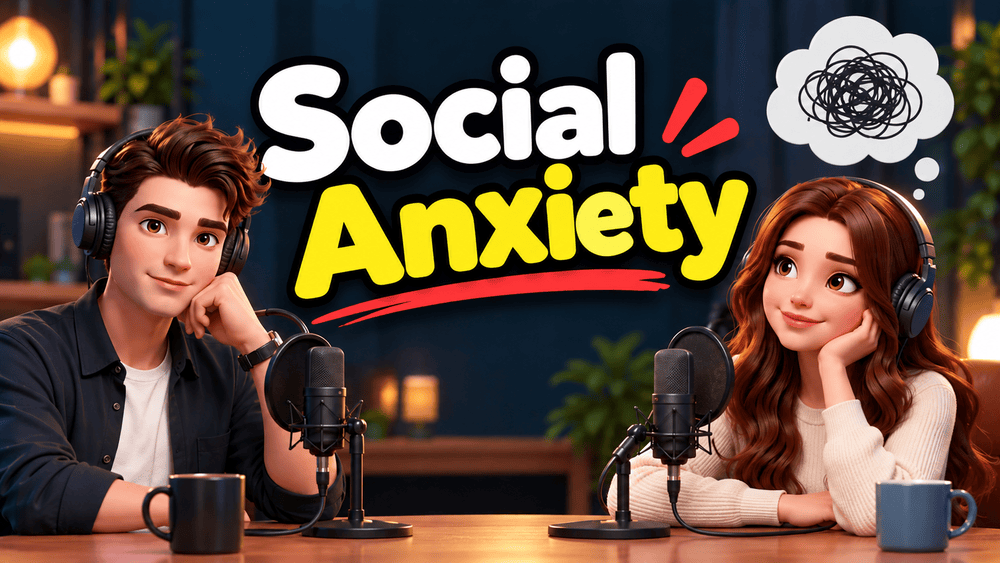
Speaker 1: Have you ever wanted to say something in a group, but suddenly your mind went completely blank?
Speaker 2: Oh, yes! That has happened to me many times. I have something to say, but when everyone looks at me, I suddenly forget my words.
Speaker 1: Really? And do you ever think about a conversation for hours after it finishes?
Speaker 2: Absolutely! Sometimes I go home and start thinking, “Why did I say that? Did I sound strange? Did they think I was boring?”
Speaker 1: That’s exactly what we’re talking about today. Social anxiety.
Speaker 2: Yes! And I think many people experience these feelings, even if they don’t talk about them.
Speaker 1: Welcome back, everyone! You’re listening to the Sam and Anji English Podcast.
Speaker 2: Hello, everyone! I’m Anji, and I’m really happy you’re spending some time with us today.
Speaker 1: And I’m Sam. How are you doing today, Anji?
Speaker 2: I’m doing well, Sam. How about you?
Speaker 1: I’m good! And I’m excited about today’s topic because it’s something that can affect our everyday lives.
Speaker 2: That’s right. Today, we’re going to talk about social anxiety in simple English. We’ll share everyday examples, talk about common feelings, and discuss some ways to feel more comfortable around other people.
Speaker 1: And don’t worry. This isn’t a difficult psychology lesson. We’re just having a friendly conversation.
Speaker 2: Exactly. So, Sam, let’s start with a simple question. What does social anxiety mean to you?
Speaker 1: Well, I think social anxiety is when someone feels very nervous or uncomfortable in social situations.
Speaker 2: Social situations? Can you give us some examples?
Speaker 1: Of course! Meeting new people, speaking in front of a group, going to a party, making a phone call, or even eating in a restaurant with other people.
Speaker 2: Interesting. So, something that looks very normal to one person can feel really difficult to another person.
Speaker 1: Exactly. Imagine you’re invited to a birthday party. Everyone is talking, laughing, and enjoying themselves. But you stand in one corner, holding your phone, because you don’t know how to start a conversation.
Speaker 2: Oh, I know that feeling! Sometimes you want to talk to people, but you just don’t know what to say.
Speaker 1: And you may start thinking, “What if they don’t like me? What if I say something silly? What if nobody wants to talk to me?”
Speaker 2: Those thoughts can make a simple situation feel much bigger than it really is.
Speaker 1: Yes. And one important thing to remember is that feeling nervous sometimes is normal. It doesn’t automatically mean you have social anxiety.
Speaker 2: That’s an important point. Everyone feels nervous from time to time. For example, I sometimes feel nervous before meeting someone for the first time.
Speaker 1: Really? You seem so comfortable when you talk to people.
Speaker 2: Well, that’s what you see from the outside! I also have moments when I feel unsure of myself.
Speaker 1: I think that’s something many people can relate to. We often believe that other people are confident all the time.
Speaker 2: Yes, but we don’t always know what’s happening inside someone’s mind.
Speaker 1: That’s true. Someone may be smiling and talking, but inside, they may be feeling nervous.
Speaker 2: Sam, let me ask you something. Have you ever avoided going somewhere because you were afraid of meeting people?
Speaker 1: Yes! I remember being invited to a small gathering. I wanted to go, but I kept making excuses in my mind.
Speaker 2: What kind of excuses?
Speaker 1: I thought, “Maybe I’ll be too quiet. Maybe everyone will already know each other. Maybe I’ll have nothing interesting to say.”
Speaker 2: And did you go?
Speaker 1: Actually, no. I stayed home.
Speaker 2: Did you feel better?
Speaker 1: At first, yes. I felt relaxed because I didn’t have to meet anyone. But later, I felt a little disappointed because I had missed an opportunity to spend time with people.
Speaker 2: That’s interesting. Sometimes avoiding a situation makes us feel better for a short time, but it doesn’t always help us feel more confident in the future.
Speaker 1: Exactly. And that’s why understanding our feelings is important.
Speaker 2: Let’s talk about another common situation: meeting new people.
Speaker 1: Oh, that’s a big one! Imagine you’re at a family event, and someone you don’t know walks toward you.
Speaker 2: They smile and say, “Hi! How are you?”
Speaker 1: And suddenly, your brain starts working very hard. You think, “What should I say? Should I smile? Should I ask their name? What if the conversation becomes awkward?”
Speaker 2: But the other person may simply be trying to make a friendly connection.
Speaker 1: Right. And you don’t need to give a perfect answer. You can simply say, “I’m good, thank you. How about you?”
Speaker 2: Or you can ask, “Have you been here before?”
Speaker 1: That’s a good question. Another easy one is, “How do you know the host?”
Speaker 2: See? Starting a conversation doesn’t have to be difficult. Sometimes one simple question is enough.
Speaker 1: And here’s something I want our listeners to remember: you don’t need to impress everyone you meet.
Speaker 2: That’s a lovely point. You can just be yourself. You don’t have to be the funniest or the most interesting person in the room.
Speaker 1: Exactly. A normal conversation is not a performance.
Speaker 2: Let’s move to another situation. Speaking in a group.
Speaker 1: Oh, this can be uncomfortable for many people. Imagine you’re sitting with five friends. Everyone is sharing stories, and you have something to say.
Speaker 2: But before you speak, you start checking every word in your mind.
Speaker 1: You think, “Is this sentence correct? Is my story interesting? Will they laugh at me?”
Speaker 2: And while you’re thinking, someone else starts talking.
Speaker 1: Yes! Then you miss your chance, and you feel frustrated.
Speaker 2: I think this can be especially difficult for people who are learning English.
Speaker 1: Absolutely. They may know what they want to say, but they worry about grammar, pronunciation, and making mistakes.
Speaker 2: But Sam, do you think people really notice every small mistake we make?
Speaker 1: Most of the time, no. People are usually thinking about their own words and their own experiences.
Speaker 2: That’s true. We often pay much more attention to our mistakes than other people do.
Speaker 1: Exactly. Imagine you pronounce one English word incorrectly during a conversation. You may remember that moment for the rest of the day.
Speaker 2: But the person listening may forget it after a few seconds.
Speaker 1: Right! They may even understand you perfectly and continue the conversation without thinking about it.
Speaker 2: So, we shouldn’t expect ourselves to speak perfectly.
Speaker 1: Not at all. Communication is about sharing your message, not giving a perfect speech.
Speaker 2: I love that. Let’s talk about something else that happens to many people: making phone calls.
Speaker 1: Oh, phone calls! Some people feel comfortable talking face to face but become nervous when they have to make a phone call.
Speaker 2: That’s interesting. Why do you think that happens?
Speaker 1: Maybe because they cannot see the other person’s face. They don’t know if the person is smiling, confused, or getting impatient.
Speaker 2: That makes sense. I know someone who can talk for an hour with a friend in person but feels nervous when calling a restaurant to book a table.
Speaker 1: And sometimes people prepare the entire conversation before making the call.
Speaker 2: They write down what they want to say, practice it several times, and still feel nervous when the phone starts ringing.
Speaker 1: But preparing a few simple sentences can actually help.
Speaker 2: For example, if you want to book a table, you can say, “Hello, I’d like to book a table for two, please.”
Speaker 1: And if you don’t understand something, you can say, “Sorry, could you repeat that?”
Speaker 2: These are simple sentences, but they can make a phone call feel easier.
Speaker 1: Another thing is that you don’t need to answer immediately. It’s okay to pause for a moment and think.
Speaker 2: Yes. A short pause doesn’t mean you’ve failed. It’s just a normal part of conversation.
Speaker 1: Anji, do you think social anxiety can affect friendships?
Speaker 2: Definitely. Someone may want to make friends but feel afraid to take the first step.
Speaker 1: For example, they see someone sitting alone at work or school. They want to say hello, but they worry that the person won’t respond.
Speaker 2: So they stay quiet, even though they would really like to connect.
Speaker 1: And later, they may think, “I should have said something.”
Speaker 2: I think we should remember that making friends doesn’t happen in one perfect conversation.
Speaker 1: Absolutely. Friendships often grow through small moments.
Speaker 2: A simple hello, a friendly question, sharing a meal, or asking someone about their day.
Speaker 1: You don’t have to become best friends immediately.
Speaker 2: Exactly. You can take your time and allow the connection to grow naturally.
Speaker 1: There’s another thing I want to discuss: worrying about what other people think.
Speaker 2: Oh, that’s a big part of the experience for many people. Sometimes we imagine that everyone is watching us.
Speaker 1: You walk into a room, and you think everyone noticed your clothes, your hairstyle, or the way you entered.
Speaker 2: Or you say something, and then you wonder whether people found it boring.
Speaker 1: But here’s a question: how often do you remember what another person wore last Tuesday?
Speaker 2: Honestly? Almost never!
Speaker 1: Exactly! We often spend a lot of time worrying about things that other people may not even remember.
Speaker 2: That’s a good reminder. People have their own lives, their own worries, and their own things to think about.
Speaker 1: Yes. And we don’t need to guess what everyone is thinking.
Speaker 2: But Sam, what if someone actually makes a negative comment? What if somebody laughs at us?
Speaker 1: That’s a fair question. Sometimes people do make unkind comments. We can’t control what everyone says or thinks.
Speaker 2: So what can we control?
Speaker 1: We can control how we respond, how we treat ourselves, and whether we allow one person’s opinion to decide our value.
Speaker 2: That’s important. One person’s comment doesn’t define who we are.
Speaker 1: Exactly. And being quiet doesn’t mean you’re boring. Being nervous doesn’t mean you’re weak. And making a mistake doesn’t mean you’re less valuable than anyone else.
Speaker 2: I hope everyone listening remembers that.
Speaker 1: Now, I want to talk about a situation that many English learners experience. What happens when you want to speak English, but you’re afraid of making mistakes?
Speaker 2: That’s a very important topic, Sam. Because sometimes people understand English quite well, but they don’t feel confident speaking it.
Speaker 1: They may know hundreds of words, understand grammar, and watch English videos every day. But when someone asks them a question in English, they become nervous.
Speaker 2: They start translating everything in their head.
Speaker 1: And they worry that the other person will judge their accent or grammar.
Speaker 2: But learning a language means making mistakes. That’s part of the process.
Speaker 1: Absolutely. Think about children learning their first language. They don’t wait until they can speak perfectly before talking to people.
Speaker 2: They try, make mistakes, learn new words, and try again.
Speaker 1: And adults can learn in a similar way. We don’t need to wait until we’re perfect.
Speaker 2: We can start with short conversations. We can ask simple questions and share small ideas.
Speaker 1: For example, instead of trying to explain a complicated story, start with something simple like, “I had a busy day today.”
Speaker 2: Then add one more detail: “I had a busy day today because I had a lot of work.”
Speaker 1: And suddenly, you’ve started a conversation!
Speaker 2: That’s right. Small steps can make a difference.
Speaker 1: But here’s something I’m curious about, Anji. Why do some people feel nervous even when they are with people they already know?
Speaker 2: That’s a very good question. Sometimes familiarity doesn’t remove all nervous feelings. Someone may feel comfortable with one friend but nervous when the whole family is together.
Speaker 1: Or they may feel relaxed with a close friend but uncomfortable when that friend brings someone new.
Speaker 2: Exactly. Social situations can be different, even when the people are familiar.
Speaker 1: So, it’s not always about whether we know the people. Sometimes it’s about how we feel in that moment.
Speaker 2: Yes. And we should try to understand those feelings instead of being angry with ourselves.
Speaker 1: I agree. We shouldn’t say things like, “Why am I so strange?” or “Why can’t I be normal?”
Speaker 2: Instead, we can say, “I’m feeling nervous right now, and that’s okay. I can take my time.”
Speaker 1: That’s a much kinder way to speak to ourselves.
Speaker 2: And I think that’s a good place to pause our conversation for a moment. But we still have more to discuss.
Speaker 1: Absolutely! We haven’t talked about practical ways to feel more comfortable in social situations, how to handle awkward moments, or what to do when anxiety feels overwhelming.
Speaker 2: And I have a few everyday examples that I want to share with you.
Speaker 1: So, don’t go anywhere. In the next part, we’ll continue our conversation and explore some small steps that may help people feel more comfortable around others.
Speaker 1: So, Anji, let’s talk about something practical. How can we feel more comfortable in social situations?
Speaker 2: I think the first step is to stop putting too much pressure on ourselves. We don’t have to be perfect. We don’t have to say something interesting every minute.
Speaker 1: That’s a good point. Sometimes we expect too much from ourselves. We want everyone to like us, every conversation to go well, and every moment to feel comfortable.
Speaker 2: But real life doesn’t work that way. Sometimes conversations are quiet. Sometimes we say the wrong thing. And sometimes we don’t know what to say.
Speaker 1: And that’s completely normal. Let’s imagine someone is going to a party and feels nervous. What would you suggest?
Speaker 2: I would suggest starting with a small goal. Don’t tell yourself, “I must talk to everyone.” Just try to say hello to one person.
Speaker 1: I like that! One small step is much easier than trying to do everything at once.
Speaker 2: Exactly. You can ask a simple question like, “How do you know the host?” or “Have you tried the food?”
Speaker 1: And if the conversation goes well, great! If it doesn’t, that’s okay too. You can politely move on.
Speaker 2: Another helpful idea is to focus on the other person instead of worrying about yourself.
Speaker 1: What do you mean?
Speaker 2: Well, instead of thinking, “Do I look nervous? Am I speaking correctly?” try listening carefully to what the other person is saying.
Speaker 1: That’s interesting. When we listen, we don’t need to think so much about what everyone thinks of us.
Speaker 2: Right. And listening also helps us find questions to ask.
Speaker 1: For example, if someone says they enjoy traveling, you can ask, “What’s your favorite place to visit?”
Speaker 2: Or, “Where would you like to travel next?”
Speaker 1: Simple questions can help a conversation continue naturally.
Speaker 2: But what if there’s an awkward silence, Sam?
Speaker 1: Oh, the famous awkward silence! I think we’ve all experienced it.
Speaker 2: Yes! You’re talking to someone, and suddenly nobody says anything. You start feeling uncomfortable.
Speaker 1: But silence isn’t always a problem. Sometimes people simply need a moment to think.
Speaker 2: True. We don’t need to fill every quiet moment with words.
Speaker 1: And if you want to continue the conversation, you can ask another simple question or talk about something around you.
Speaker 2: For example, “This place is really nice, isn’t it?”
Speaker 1: Exactly! You don’t need a perfect topic.
Speaker 2: Let’s talk about another important thing: being kind to yourself.
Speaker 1: I think this is one of the most important parts. Imagine you make a mistake during a conversation. Instead of thinking about it all night, remind yourself that everyone makes mistakes.
Speaker 2: Yes. You can say, “I didn’t say everything perfectly, but that’s okay. I tried.”
Speaker 1: And remember, one uncomfortable moment doesn’t mean the whole day was bad.
Speaker 2: Absolutely. We should also avoid comparing ourselves with people who seem very confident.
Speaker 1: Because we only see what they show us. We don’t always know what they feel inside.
Speaker 2: Someone who talks easily today may have felt nervous when they were younger.
Speaker 1: That’s true. Confidence can grow with time and experience.
Speaker 2: But Sam, what if someone feels so nervous that they start avoiding work meetings, social events, or everyday activities?
Speaker 1: That’s important. If these feelings are strong, continue for a long time, or affect everyday life, talking to a mental health professional can be helpful.
Speaker 2: Yes. There’s no shame in asking for support. We don’t have to handle everything alone.
Speaker 1: Exactly. Getting help is a sign that you’re taking care of yourself.
Speaker 2: I also think it’s important to remember that progress doesn’t always mean doing something big.
Speaker 1: Absolutely! Maybe today you say hello to someone new. Tomorrow, you ask a question. Another day, you join a group conversation.
Speaker 2: And slowly, you may start feeling more comfortable.
Speaker 1: That’s right. Don’t compare your progress with someone else’s. Everyone has a different journey.
Speaker 2: Before we finish, let’s share a few simple reminders for our listeners.
Speaker 1: Number one: You don’t have to impress everyone.
Speaker 2: Number two: It’s okay to be quiet sometimes.
Speaker 1: Number three: A small conversation is still progress.
Speaker 2: Number four: Making mistakes doesn’t make you less valuable.
Speaker 1: And number five: Take small steps, be patient with yourself, and ask for help when you need it.
Speaker 2: I love those reminders. And I want to ask everyone listening one question.
Speaker 1: What’s that?
Speaker 2: What’s one social situation that makes you feel nervous? Is it meeting new people, speaking in a group, making phone calls, or attending parties?
Speaker 1: Share your experience in the comments. You don’t need to write a long answer. Even one simple sentence is enough.
Speaker 2: And remember, your English doesn’t need to be perfect. This is a place to learn and express yourself.
Speaker 1: That’s right! We hope today’s conversation helped you understand social anxiety and gave you some useful English expressions.
Speaker 2: And perhaps it reminded you that you’re not alone in experiencing these feelings.
Speaker 1: Thank you for spending your time with us today. If you enjoyed this conversation, please like the video and subscribe to the Sam and Anji English Podcast.
Speaker 2: Share this episode with a friend who is learning English. And don’t forget to keep practicing your English through everyday conversations.
Speaker 1: Take care of yourself, keep learning, and remember that you don’t need to be perfect to connect with people.
Speaker 2: Be patient with yourself, be kind to yourself, and believe that small steps matter.
Speaker 1: We’ll see you in the next episode!
Speaker 2: Goodbye, everyone! See you soon!